


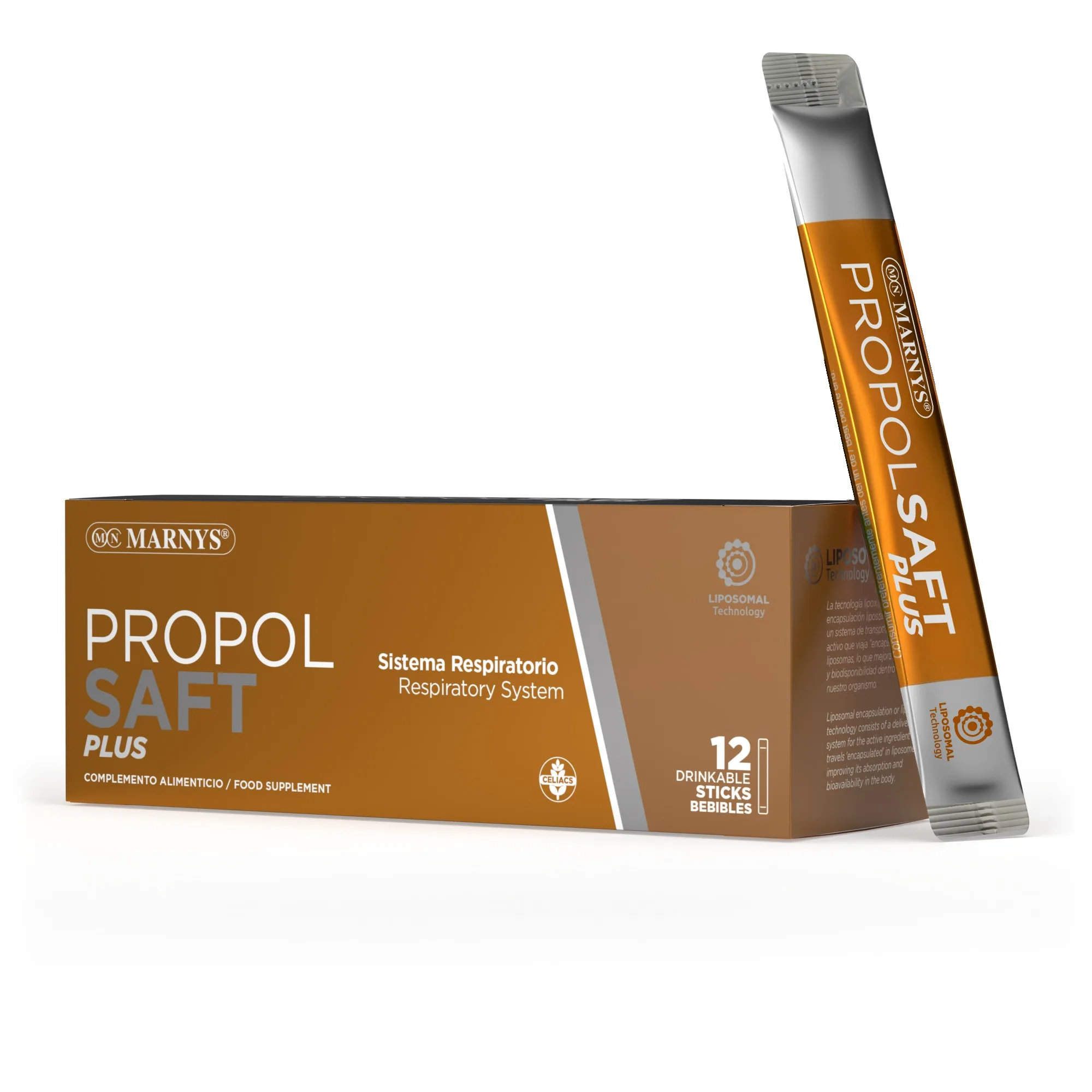
Propalsaft Plus
Feel Lighter When Breathing
Feeling of Smoothness and Comfort in Your Respiratory Tract. Featuring N-acetyl-L-cysteine, Propolis, Acerola, and Thyme in a Drinkable Stick.
Information on PROPOLSAFT PLUS, 12 sticks x 15 ml
PROPOLSAFT PLUS and its ingredients support the efficient relief of the most common lower respiratory tract discomforts.
PROPOLSAFT PLUS includes liposomal technology in its ingredients, which increases the bioavailability of the active principles in the body.
? Ask us your questions
Share on social networks
FREQUENTLY ASKED QUESTIONS ABOUT DIGESHELP
TO LEARN MORE
How Does Breathing Occur?
The respiratory system is a complex biological apparatus, resembling a network of paths and filters that carry air from the outside to every cell in the body. Its main function is gas exchange: taking in the oxygen we need to live and releasing carbon dioxide, a waste product.
The process begins with inspiration, whereby air enters through the upper airways (nasal passages or oral cavity), continuing its journey through the pharynx to the trachea, a cartilaginous tube. The trachea divides into two large branches called bronchi, one for each lung. These bronchi branch off repeatedly into increasingly smaller tubes, the bronchioles, until reaching the alveoli.
The lungs are filled with millions of these tiny air sacs, the alveoli, surrounded by a network of tiny blood vessels. This is where gas exchange occurs: oxygen from the air we breathe in passes into the blood through the thin walls of the alveoli, and at the same time, carbon dioxide from the blood passes into the alveoli to be exhaled. It's a constant and efficient exchange.
All this process is orchestrated by the diaphragm and the intercostal muscles, which contract and relax to expand and contract the lungs, creating the movement of inhalation and exhalation.
What Can Affect the Functioning of the Respiratory Tract?
Although our respiratory system is very resilient, various conditions can affect its functioning, making it difficult to breathe freely. Examples of these include:
Respiratory infections. These are the most common, caused by viruses or bacteria that inflame the airways and increase mucus production. This causes cough, nasal congestion, and difficulty breathing (dyspnoea).
Respiratory allergies. They arise when the immune system overreacts to allergens, causing inflammation in the airways.
Chronic respiratory diseases. Long-term conditions that damage the lungs and airways, often progressive.
Environmental factors and habits. Continuous exposure to irritants harms lung function. Tobacco is the leading cause of chronic respiratory diseases and increases the risk of infections, while air pollution also inflames the airways.
Understanding these factors is key to taking care of our respiratory health and maintaining an active and healthy life.
Refrances
- Barrett KE, et al. Ganong's Medical Physiology, 26th Edition. 2020.
- Boron, WF, et al. Medical Physiology, Edition 3. 2016.
- Dellacá R & Aliverti A. Respiratory Physiology: New Knowledge, Better Diagnosis. European Respiratory Society Publications 2025.
- Hall JE & Hall ME. Guyton and Hall Textbook of Medical Physiology, 14th Edition. 2021
- Respiratory System. [Internet]. Cleveland: Cleveland Clinic; [Updated Feb 2024; accessed May 2025]. Available at https://my.clevelandclinic.org/health/body/21205-respiratory-system
- The Respiratory System. [Internet]. Bethesda: NIH: National, Heart, Lung, and Blood Institute; [Updated Mar 2022; accessed May 2025]. Available at https://www.nhlbi.nih.gov/health/lungs/respiratory-system

Related products




Only logged in customers who have purchased this product may leave a review.






Reviews
There are no reviews yet.